For most enterprises, data governance has matured into a well-documented discipline. Policies exist. Frameworks are defined. Compliance requirements are mapped. Yet despite this progress, many security and risk leaders still face a persistent and uncomfortable truth: having a governance model does not mean having governance control.
The modern enterprise environment is no longer confined to well-scoped systems or predictable infrastructure. Data now flows through cloud platforms, SaaS applications, unmanaged assets, and an expanding network of third-party integrations. In this environment, the real challenge is not writing governance rules; it is ensuring those rules are actually enforced across systems that are constantly changing, often without central visibility.
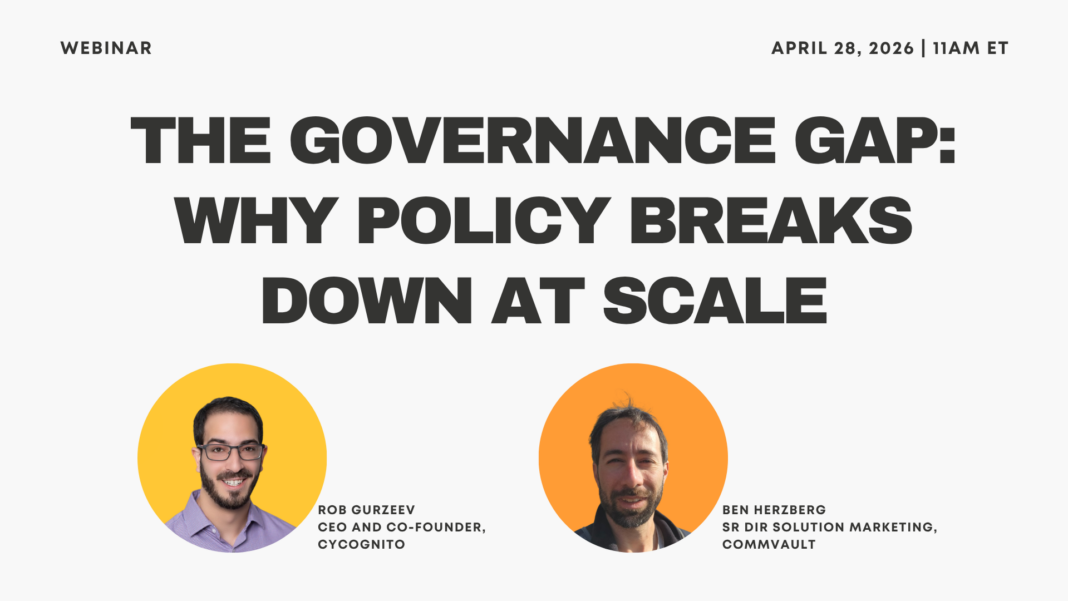
This tension between “defined policy” and “actual exposure” is the focus of an upcoming webinar hosted by CyCognito titled “The Governance Gap: Why Policy Breaks Down at Scale,” taking place on April 28 at 11AM ET. The session brings together practitioners who sit at the intersection of external exposure discovery and enterprise data governance, aiming to unpack why organizations continue to struggle with enforcement at scale.
On one side is Rob N. Gurzeev, CEO and Co-Founder of CyCognito, whose work centers on mapping enterprise attack surfaces the way real adversaries see them without relying on predefined inputs or internal assumptions. On the other is Ben Herzberg, Senior Director of Solution Marketing at Commvault, a leader focused on helping enterprises turn data protection and governance into a strategic enabler rather than a compliance burden.
Together, they approach the same problem from different angles: how organizations lose alignment between what they believe is governed and what is actually exposed or accessible in practice.
The Hidden Breakdown Between Policy and Exposure
At its core, the governance gap is not a failure of intent. Most enterprises already have robust frameworks covering data classification, access control, retention, and compliance mapping. The breakdown happens at execution, particularly when scale introduces complexity faster than governance models can adapt.
Modern environments introduce three major friction points. First is visibility: organizations often lack a complete, real-time understanding of what assets exist externally, especially when shadow IT and decentralized cloud adoption are involved. Second is access drift, where permissions accumulate, inherit incorrectly, or remain active long after their original purpose has expired. Third is third-party exposure, where integrations and vendor ecosystems extend data flows far beyond internal boundaries.
From an attacker’s perspective, these gaps are not theoretical; they are entry points. Gurzeev’s approach at CyCognito is built around this idea: that the most critical risks are not the ones organizations know about, but the ones they never mapped in the first place. By continuously analyzing external attack surfaces using machine learning and automated testing, CyCognito aims to surface exposures that traditional scanners and governance tools often miss entirely.
Herzberg’s perspective complements this by focusing on what happens after visibility is achieved. Even when organizations identify data exposure or misalignment, enforcement becomes the next challenge. Governance systems must not only detect issues but also ensure that controls remain consistent as environments evolve, particularly in highly dynamic cloud-native architectures.
Rethinking Governance as a Continuous System
The webinar is expected to explore a shift that many security leaders are currently grappling with: governance can no longer be treated as a static policy layer sitting above infrastructure. Instead, it must function as a continuous, adaptive system that reflects real-world exposure and access patterns as they change.
This requires aligning three domains that are often managed separately, visibility into external exposure, internal access control, and enterprise-wide governance frameworks. When these systems operate in isolation, gaps are inevitable. When they are connected, organizations gain a more accurate understanding of what is actually protected versus what is simply assumed to be secure.
Closing Perspective
As enterprise environments continue to scale in complexity, the governance gap is becoming one of the most persistent security challenges across industries. The issue is no longer whether governance frameworks exist, but whether they remain valid in the face of constant infrastructure change.
“The Governance Gap: Why Policy Breaks Down at Scale” positions itself as a practical discussion for leaders trying to bridge this disconnect between policy and reality. By combining external exposure intelligence with enterprise governance strategy, the session aims to outline what it takes to move from static control models to continuous enforcement.
The webinar takes place on April 28 at 11AM ET. Registration is available via CyCognito’s official webinar page for those looking to explore how governance can be made operational at scale.