
For years, cybersecurity education has largely followed a predictable formula: certification tracks, dense technical documentation, conference presentations, and endless threat reports. While effective for specialists, those formats rarely capture the broader story of how cybersecurity evolved into one of the world’s most strategically important industries.
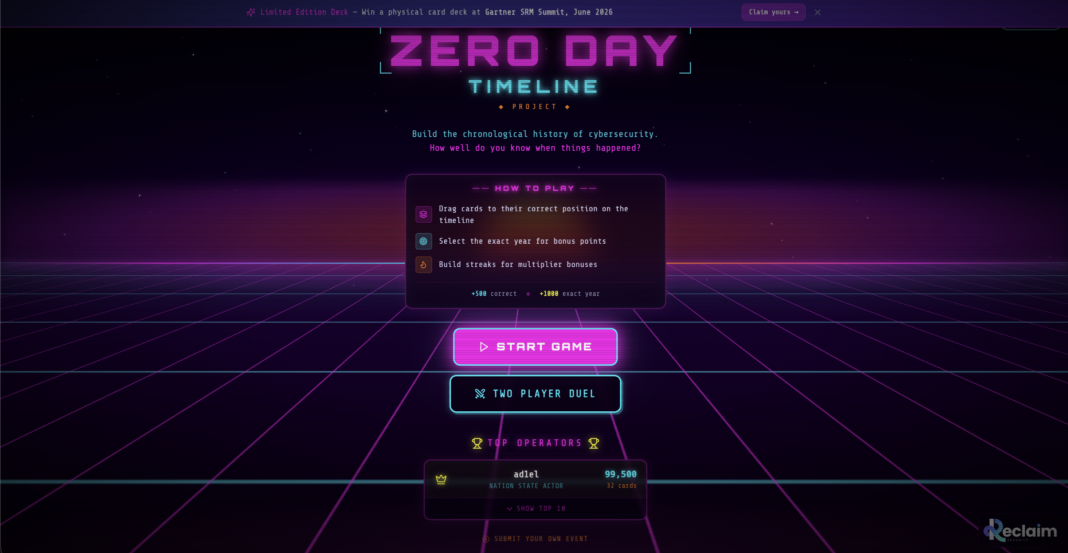
Reclaim Security is attempting to change that dynamic with “Zero Day Timeline,” a competitive card game built around the history of cybersecurity.
Rather than teaching through lectures or training modules, the game challenges players to reconstruct decades of cybersecurity history event by event, testing not only technical awareness but also cultural literacy across the security ecosystem.
In many ways, the launch reflects a broader transformation taking place across enterprise learning itself: the move from passive education toward engagement-driven experiences.
Turning Cybersecurity Into A Playable Narrative
Zero Day Timeline is structured around a deceptively simple concept. Players receive cards representing major moments in cybersecurity history and must place them in the correct chronological order along a timeline.
The gameplay quickly becomes more difficult than expected.
Distinguishing whether a landmark breach happened before or after the rise of cloud-native security, remembering when a major hacker conference began, or identifying the precise year of a historic malware outbreak forces players to contextualize the industry’s evolution in real time.
Each correct placement earns points, while identifying the exact year unlocks bonus scoring opportunities. Streaks multiply rewards, adding competitive pressure that rewards consistency as much as accuracy.
Three incorrect answers end the session, though players can strategically deploy specialized “SOC Toolkit” abilities designed around familiar security terminology.
An “NMAP Scan” hints at the correct decade of an event. A “Sandbox” absorbs a wrong answer and protects a streak. “Threat Intel” reveals the exact year of a card when precision becomes essential.
The mechanics feel intentionally designed for cybersecurity professionals, borrowing operational language from security operations centers and threat analysis workflows rather than traditional gaming terminology.
Mapping The Industry’s Defining Moments
What makes the game particularly compelling is the diversity of the events included.
Some cards focus on deeply technical milestones, such as the 1988 Morris Worm or the 2021 Log4Shell vulnerability, both of which reshaped how the industry thought about systemic risk.
Others highlight the cultural infrastructure that helped define hacker communities. DEF CON 1, founded by Jeff Moss, appears alongside AppSec Village’s emergence at DEF CON decades later, illustrating how application security evolved into its own specialized discipline.
The game also captures moments when cybersecurity became inseparable from geopolitics and mainstream society. The Sony Pictures breach, the Democratic National Committee investigation involving CrowdStrike, and the SolarWinds compromise all reflect how cyber incidents increasingly influence public trust, international relations, and corporate governance.
Corporate consolidation also becomes part of the narrative. Cards reference major acquisitions such as Google purchasing Mandiant and Symantec acquiring Veritas, demonstrating how cybersecurity evolved into a central pillar of enterprise technology strategy.
The result is a playable archive of the industry itself.
The Rise Of Competitive Learning In Security
The popularity of capture-the-flag competitions and hacking labs has already demonstrated that cybersecurity professionals often learn best through interaction rather than observation.
Zero Day Timeline extends that philosophy into historical literacy.
Instead of memorizing timelines through static reading, players engage with the material dynamically. The ability to open “Read_More” explanations for every card transforms gameplay into a layered educational experience where curiosity becomes part of progression.
The game’s leaderboard system adds another dimension. High-scoring players can compete publicly under custom handles, while social sharing options across LinkedIn, X, Facebook, and Reddit encourage broader participation.
There is also a two-player duel mode requiring account registration, introducing a direct competitive environment that mirrors the collaborative and adversarial dynamics already present throughout cybersecurity culture.
Importantly, the platform invites users to submit additional historical events for inclusion in future decks. That decision positions the game less as a static product and more as a living historical record curated by the community itself.
Why Historical Context Is Becoming Strategic
Cybersecurity is increasingly shaped by recurring patterns.
Supply-chain attacks, ransomware campaigns, regulatory responses, vulnerability disclosure debates, and software liability discussions rarely emerge in isolation. They build upon decades of prior incidents, technical innovations, and policy failures.
By compressing that history into a competitive format, Reclaim Security is tapping into something larger than nostalgia.
The game’s inclusion of recent milestones, including the rise of CNAPP platforms, AI governance developments, and preemptive security models, reflects how rapidly the industry continues to evolve. Understanding those transitions may become essential for practitioners navigating what comes next.
Reclaim Security will also offer a limited-edition physical version of the deck during the Gartner Security & Risk Management Summit 2026 at the Gaylord National Resort & Convention Center from June 1–3, where the company will appear at Booth #652.
In an industry obsessed with predicting future threats, Zero Day Timeline makes a different argument: understanding cybersecurity’s past may be one of the best ways to prepare for what comes next.

John Kevin Hao is a news and feature writer covering cybersecurity, technology, and business targeted for professional audiences.