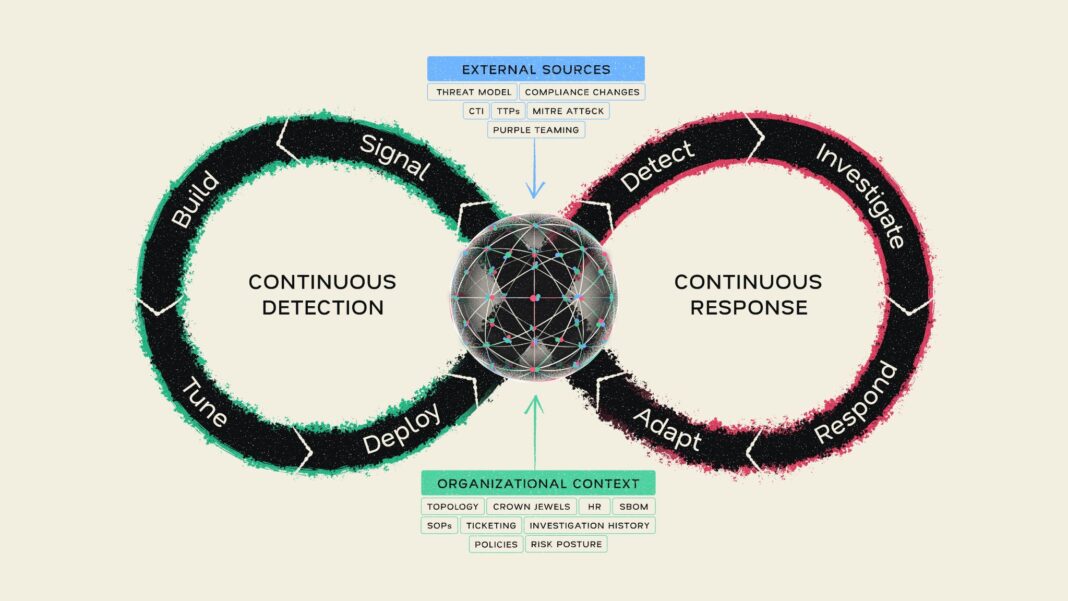
Security operations have spent years accumulating data, not scaling visibility. Modern SOCs ingest massive volumes of telemetry across cloud infrastructure, endpoints, identity systems, and SaaS platforms, yet still rely on workflows designed for humans. The core issue is not a lack of data, but fragmentation: detection and investigation exist as separate processes stitched together through tooling rather than unified reasoning.
Mate Security is introducing Continuous Detection, Continuous Response (CD/CR) as a new framework implemented through its platform. Instead of treating detection and investigation as distinct stages in a linear pipeline, Mate connects them into a continuous feedback loop designed for machine-speed environments. Investigations directly improve detection logic, and detections continuously evolve based on investigative outcomes. The SOC becomes less of a pipeline and more of a self-improving system operating at the pace of modern threats.
The Fragmentation Problem in Modern SOCs
The traditional SOC model reflects how security tools evolved, not how security problems actually behave. Detection engineering teams write rules based on known patterns, while analysts investigate alerts generated by those rules. These functions operate in parallel but rarely in sync.
Historically, this model was reinforced by a centralized data assumption: that all security-relevant information must be collected into a single system, most commonly a SIEM, before it could be useful. While this assumption is already starting to shift, with many organizations migrating SIEM data into data lakes to reduce cost and improve efficiency, the operational model of centralized ingestion still largely defines how most SOCs function.
If it was not in the SIEM, it effectively did not exist within the detection and investigation workflow. That approach was built for a world where humans were the primary actors in the system, writing queries, reviewing logs, and making decisions at human speed.
That assumption is now under strain. Modern environments are distributed by design, spanning cloud platforms, SaaS systems, identity providers, IT infrastructure, and business applications. At the same time, attackers increasingly operate at machine speed, compressing detection and response windows beyond what manual pipelines can reliably handle.
Over time, the separation between detection and investigation creates compounding inefficiencies. Detection rules degrade as environments change, often breaking silently when infrastructure shifts or context evolves. At the same time, many relevant attack paths are never built into detection logic because they require investigative reasoning that sits outside static rule creation.
Investigations introduce a different challenge. Analysts resolve alerts under pressure, but the reasoning behind decisions is rarely structured in a way that feeds back into detection systems. As a result, valuable knowledge is repeatedly recreated instead of being retained and scaled.
The outcome is a SOC that is operationally busy but structurally stagnant, constantly reacting without systematically improving, and increasingly misaligned with the speed of modern threats.
Continuous Detection as a Feedback Loop
Continuous Detection, Continuous Response reframes this entire model as a single continuous discipline rather than a sequence of disconnected stages.
Detection and investigation are not separate phases but two expressions of the same underlying reasoning cycle.
Every investigation becomes a learning event. When analysts resolve an incident, their decision path is captured and used to refine detection logic. This shifts detection from being based on static assumptions or periodic engineering cycles to being grounded in real-world organizational behavior.
Every detection is also continuously enriched by prior investigations. Alerts are no longer isolated events but context-aware signals shaped by accumulated understanding of how similar behavior has manifested within the environment. This reduces ambiguity and compresses the time between signal and decision.
Instead of relying on periodic tuning cycles or manual rule updates, the system improves continuously as part of normal operations. Learning is embedded into execution itself, allowing the SOC to adapt at the same velocity as changing infrastructure and evolving threats.
The Security Context Graph as the Core Layer
At the center of this model is Mate’s Security Context Graph, a dynamic representation of organizational knowledge that acts as the contextual foundation for the entire system. From day one, Mate has built its platform on this graph, using it as the backbone for context-driven investigations that continuously reinforce the same knowledge structure now used for detection and response.
It extends beyond telemetry to include architecture, crown jewel assets, compliance requirements, identity structures, threat models, business logic, and historical investigations. Increasingly, it can also incorporate signals from across distributed enterprise systems, such as security tools, IT platforms, HR systems, and line-of-business applications, without requiring everything to be centralized into a single repository.
This distinction is critical. Modern security data is inherently distributed, and while organizations are increasingly shifting SIEM data into data lakes to reduce cost and improve efficiency, forcing ingestion into a single platform for operational use still often slows down both detection and response while increasing cost and operational friction. The Security Context Graph is designed to operate across that reality, preserving context without requiring data consolidation.
Telemetry alone can describe events, but it cannot express meaning or priority. A suspicious authentication event is only relevant when understood in context: what system it touched, how critical that system is, and what prior investigative outcomes suggest about similar behavior in that environment.
The Security Context Graph provides this missing layer of meaning. It ensures that every detection and investigation is interpreted through the lens of organizational reality rather than generic security heuristics.
As investigations are completed, they update the graph. As the graph evolves, it reshapes how future detections are generated, prioritized, and correlated. The system becomes continuously aligned with the organization it protects, not just its data exhaust.
From Static Pipelines to Adaptive Security
This architecture fundamentally changes how SOCs scale.
Traditional models scale through more rules, more tools, and more analysts. Continuous Detection, Continuous Response scales through increased reasoning density within the system itself, allowing intelligence to compound rather than infrastructure to expand.
False positives decline because detections are grounded in real investigative outcomes rather than static assumptions. Coverage improves because repeated investigative patterns are automatically compressed into reusable detection logic. Operational costs stabilize as organizations reduce dependency on centralized data ingestion and instead operate across distributed systems where data remains in place but still contributes to detection and response.
Most importantly, the SOC becomes adaptive by default. Changes in infrastructure, threat landscape, or business priorities are reflected in the Security Context Graph and propagated into detection and response behavior without waiting for manual tuning cycles.
In an environment defined by machine-speed attackers, this shift is not incremental. It is structural.
A Self-Improving SOC Model
CD/CR represents a shift from static tooling to an adaptive security framework.
By unifying detection and investigation into a continuous loop, Mate Security enables a SOC that learns from its own operations in real time.
Investigations strengthen detections. Detections improve investigations. Both are grounded in a shared contextual model of the organization that evolves continuously with every interaction. Over time, the SOC stops behaving like a collection of disconnected processes and becomes a continuously improving system of intelligence that is designed not just to keep up with change, but to operate at the speed at which change now occurs. CD/CR is not simply a workflow improvement. It is a new framework and an emerging SOC discipline built around the principle that detection and investigation must function as a single continuous system designed to help defenders outpace attackers in the machine age.