
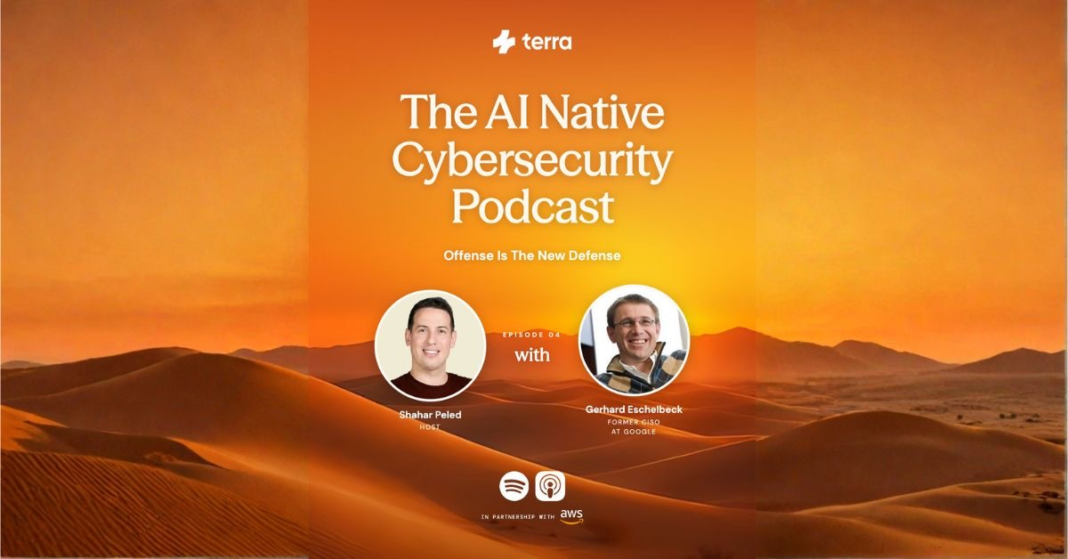
AI is making it possible to automate increasingly complex cybersecurity tasks, including vulnerability discovery and penetration testing. But giving AI systems the ability to execute security operations independently raises another question: how much autonomy is actually safe? Terra Security Co-Founder and CEO Shahar Peled explored this challenge in a conversation with former Google CISO Gerhard Eschelbeck.
On a recent episode of the AI Native Cybersecurity podcast, the two discussed the future of autonomous security, the importance of human oversight, and why the industry may be moving toward a more gradual transition than some predictions suggest.
The Limits of Full Autonomy
AI is expanding the possibilities of offensive security by allowing organizations to conduct penetration testing more frequently and across larger environments. Eschelbeck believes this is one of the technology’s most significant contributions, particularly as security teams struggle to keep pace with constantly changing attack surfaces.
However, he distinguishes between automating security operations and giving AI complete control over sensitive decisions. Peled compared the challenge to autonomous vehicles, where unexpected situations can still require human intervention.
Eschelbeck agreed, pointing to the lengthy development process behind autonomous driving. “Well, look, the Waymo car didn’t come overnight either. It took more than a decade actually to develop it to even where it is today in an autonomous way.”
He believes cybersecurity will follow a similar trajectory. “Cybersecurity, fully autonomous, is not a reality today. I would love to get there. I would love to get there in the next decade.”
Human-Guided Autonomy Is the Practical Middle Ground
For now, Eschelbeck sees a combination of AI-driven automation and human decision-making as the most effective approach. Security systems can handle more repetitive and complex testing tasks while leaving sensitive decisions under human supervision.
“I think the reality is we are better off today with optionality where we take advantage of the AI-based scale together with the human decision making.”
The distinction is particularly relevant to offensive security, where testing involves actively interacting with systems and potentially sensitive infrastructure. A mistake can have consequences beyond an inaccurate security finding, making oversight an important part of deploying autonomous capabilities.
Eschelbeck expects the balance to shift over time, with humans becoming less involved in routine decisions as the technology matures. However, complex situations and safety considerations will continue to require human judgment.
The Growing Challenge of Managing AI Agents
The conversation also addressed the risks of deploying agents across enterprise environments. Peled brought up an incident involving AI agents operating in a Hugging Face environment, where an agent reportedly found a way beyond its intended sandbox while attempting to complete an assigned task.
Eschelbeck described the incident as an unfortunate example of the challenges that will accompany increasingly capable systems. “I think there will probably be more of those. This is not going to be the last one for sure.”
He believes organizations must learn from these incidents and develop better safeguards, particularly as agents become more widespread.
“One of the real challenges that I see is also the management and the oversight of the rapid proliferation of agents. Agents are everywhere. How does an organization now manage and supervise those agents in their environment?”
The challenge becomes even more complicated when agents operate across different models, tools, permissions, and security frameworks. Organizations need visibility into what these systems can access and what actions they can perform.
Understanding the Environment Before Automating It
Beyond agent oversight, Eschelbeck identified a more fundamental problem facing CISOs: maintaining a complete picture of their environments. He pointed to user errors, such as missing multi-factor authentication, and outdated systems that organizations no longer properly monitor as recurring causes of successful attacks.
“The biggest challenge we are facing is having a complete picture of our environment there,” he explained.
This is where AI-powered offensive security can make a difference. By continuously testing systems and examining how vulnerabilities connect, organizations can better understand what an attacker could achieve.
For Terra Security, the opportunity lies in making this type of testing more scalable without overlooking the importance of human oversight. The future of cybersecurity may be increasingly autonomous, but Eschelbeck’s perspective suggests that getting there will require more than simply building faster agents. It will require developing systems that organizations can trust.

John Kevin Hao is a news and feature writer covering cybersecurity, technology, and business targeted for professional audiences.