
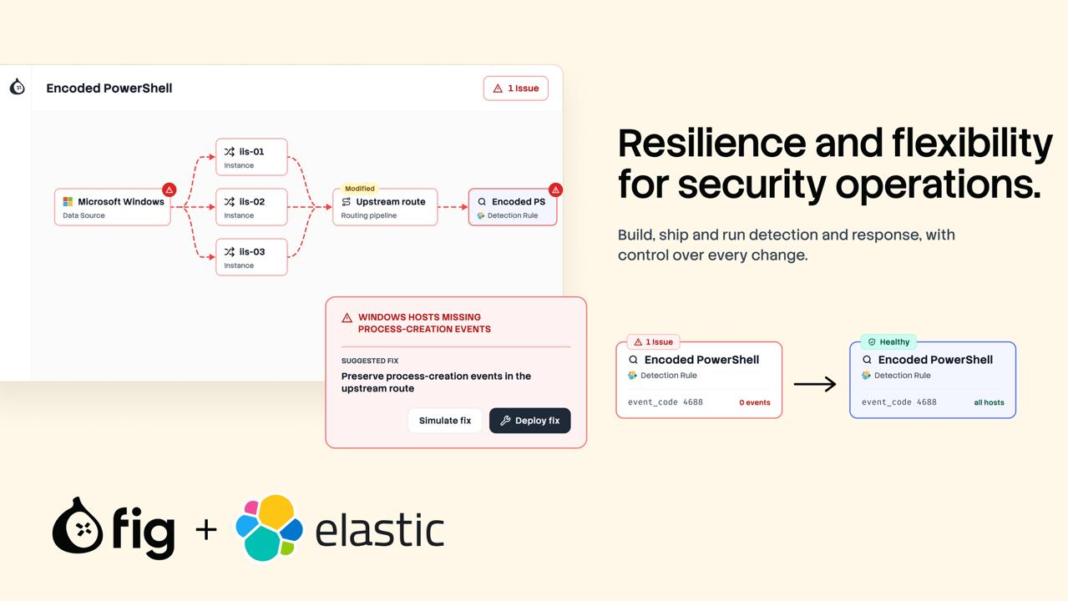
A detection rule that shows as active is not always a rule that still works. For security leaders who have to stand behind their organization’s monitoring, the difference between a rule being enabled and a rule being effective matters, and that difference can open up without an obvious signal. Fig helps security operations teams map detection dependencies, spot breaks and validate changes before production. On November 19, 2026, it announced an integration partnership with Elastic aimed at that difference. SiliconANGLE first reported the partnership.
The integration brings Fig together with Elastic Security, the open, agentic security operations platform from Elastic. The combined approach lets teams build, ship and run detection and response while keeping track of how changes to their data affect security coverage, with control over each of those changes.
When Active Rules Stop Seeing Attacks
Every rule assumes data will arrive in an expected structure, with the fields and values needed to identify suspicious activity. Those dependencies can change when vendors revise log formats, when teams introduce new sources and when upstream pipelines are reshaped for cost and performance. Each of these moves may be intentional and beneficial. They often take place in tools owned by different teams, though, which makes their effect on detection harder to follow.
The outcome is drift. Data keeps flowing and rules stay switched on, but a rule can lose the information it needs to catch the attacks it was designed for. Jamie Hynds, director of product at Elastic, described how constant that pressure is. “Environments never stop changing, from vendor schemas and APIs to ETL tools and pipelines. Fig traces those changes to the detection rules that depend on them, so SecOps teams can adapt quickly and maintain detection coverage with Elastic Security,” Hynds said. ETL refers to extract, transform and load tools, and SecOps is short for security operations.
What Fig Adds to an Elastic Security Deployment
Elastic Security provides prebuilt integrations and detection rules that help teams establish coverage from day one. Fig is designed to safeguard and expand that coverage as environments evolve by connecting upstream data changes to the downstream detections that depend on them. For a chief information security officer (CISO), the practical gain is a clearer path from discovering that something has affected coverage to addressing its cause. The partnership is designed to give Elastic users that path, along with a better understanding of the dependencies behind each detection.
Gal Shafir, co-founder and chief executive officer of Fig, described the split in responsibility plainly. “Elastic gives security teams control over their data, and Fig gives them control over the engineering around it,” Shafir said. Fig makes that engineering visible by connecting to Elastic with a read-only application programming interface (API) key and retrieving the environment’s configuration. Its deterministic Security Data Lineage then maps sources through pipelines, mappings and fields to the detection rules that use them.
Change Control That Leaders Can Stand Behind
The lineage map shows what each rule relies on before a change goes live, so engineers can weigh the impact ahead of time. When a source, pipeline or mapping changes, Fig identifies the affected detections, pinpoints where the flow has broken and recommends a fix. Engineers then use that context to investigate the issue and assess the proposed repair.
That process works alongside the capabilities Elastic already offers. Elastic’s prebuilt integrations and research-backed detection rules deliver broad coverage out of the box. Its Automatic Import feature and artificial intelligence (AI) Agent help teams build new integrations and custom rules as requirements grow. Fig tests changes against the organization’s own data and environment context before production. Engineers can then ship those changes as code using continuous integration and continuous delivery (CI/CD), with version control and one-click rollback.
For leadership, version control and one-click rollback mean changes that can be reviewed and reversed. The workflow also links every planned change to its expected effect on detection coverage, so teams can assess dependencies, test adjustments and manage deployment as they add sources, refine pipelines or expand use cases. Shafir connected these controls to speed. “Teams can see how every source connects to every detection, test each change against their own environment and ship it as code. That lets them move quickly without losing sight of their coverage,” he said.
Reducing Uncertainty Around a SIEM Migration
Coverage questions also come up when an organization changes platforms. For organizations moving to Elastic Security from another security information and event management (SIEM) platform, Elastic’s Automatic Migration translates existing detection rules. Fig then checks each translated rule against the data available in Elastic before cutover, flags rules that need rework and recommends fixes.
The validation shows engineers where translated detection logic and the destination environment’s data need to be aligned before the switch. Organizations already running Elastic can apply the same checks whenever they introduce sources or change detection use cases, so the benefit isn’t limited to the migration itself.

John Kevin Hao is a news and feature writer covering cybersecurity, technology, and business targeted for professional audiences.