
Recently featured in The Next Web, IONIX was described as one of cybersecurity’s best-kept secrets. But with AI dramatically changing how quickly vulnerabilities can be discovered and exploited, the company may not stay under the radar for much longer. We decided to sit down with the IONIX team to explore what makes its approach different and why traditional attack surface management may no longer be enough to protect modern enterprises.
With more than 100,000 CVEs published so far this year and AI accelerating exploit development, the window between vulnerability disclosure and exploitation is shrinking rapidly. In this interview, IONIX CEO Marc Gaffan discusses how IONIX discovers hidden enterprise assets, validates exposures without disrupting production environments, and helps security teams identify which vulnerabilities actually demand immediate attention. We also explore its 12-hour response commitment, the growing role of autonomous AI agents in offensive security, and its vision for a self-healing attack surface that can find and fix exposures before attackers get there.
1. What has actually changed about the time to exploitation?
Defenders have lost the head start they used to have. Attackers are moving faster, and there’s far more for them to exploit. More than 100,000 CVEs have been published so far this year, more than double last year’s total. Over the last 60 days, that’s averaged more than 550 a day, roughly four times last year’s pace. Most security teams are still working with patch cycles built for a fraction of that volume.
Take PHP2Shell, which was disclosed last month. The class of bug behind it was first flagged in 2004, when a researcher warned on the Bugtraq mailing list that PHP’s memory-limit handling could interrupt code in unsafe places. PHP patched the specific cases he reported, but the broader problem stayed in the code. It surfaced again in a 2019 bug report, which was fixed as a denial-of-service issue, and again in a 2024 security audit that didn’t prove it could be exploited. The industry had a 20-year head start and never fixed it. Researchers working with AI built a working exploit in about two weeks.
We’re seeing the same thing with NGINX. It’s some of the most heavily audited software in the world, and this month five critical remote code execution flaws were disclosed in it, most of them found through fully automated analysis.
AI and automation have made exploit development cheap, and machines are finding critical bugs that years of human review missed or ignored. Security through obscurity died with Mythos. A few years ago, a company with an exposure it didn’t know about could reasonably assume no attacker would find it, connect it back to them and exploit it. That isn’t the case anymore. If an exposure is exploitable and on the internet, assume someone will find it, and soon. Our job at IONIX is to make sure we find it for our customers first and help them mitigate it at machine speed.
2. How do you tell whether an internet-facing asset belongs to the enterprise?
For most of this market’s history, attribution started with IP blocks: find the ranges a company owns and scan them. That approach no longer works, because the overwhelming majority of an enterprise’s internet-facing assets now run on infrastructure it doesn’t own. A marketing site hosted by an agency, or a customer portal running in a public cloud, sits in someone else’s IP space, so an IP-first scan never sees it.
IONIX starts with the company’s business structure. We map it from the public record: decades of press releases, acquisition announcements, and municipal, state, federal, national, regulatory and corporate registries. Acquisitions make this especially hard. Say a media company acquires a film studio. The studio owns a visual effects house, and the effects house owns a small sound studio. If you don’t know that chain exists, you’ll never look for the sound studio’s assets, and you’ll miss that part of the parent company’s attack surface entirely.
Each attribution is backed by weighted evidence. AI builds the corporate-structure picture and produces a report explaining why each entity is in or out, and a human can review and sign off on those decisions. When the evidence is ambiguous, the IONIX platform shows the customer why we believe an asset belongs to them and how confident we are, so their team can confirm or reject it with the reasoning in front of them.
3. What exactly is behind the 30–50% discovery lift?
It comes from the method I just described. Approaches that start from IP ranges, or from a seed list the customer hands over, miss two large groups of assets: those running on infrastructure the company doesn’t own, and those inherited through subsidiaries and acquisitions. When you start from corporate structure and work down through every acquired entity and brand, you find the assets those approaches miss.
The 30–50% figure comes from putting IONIX’s method up against the alternatives. We see it in side-by-side assessments against other established ASM vendors. In one recent evaluation, a global Fortune 500 enterprise ran IONIX against ten other ASM vendors, and we found 30,000 more assets than the closest competitor.
To make sure the additional assets actually belong to the customer, they go through the same attribution process as everything else: weighted evidence, an AI-generated explanation for each entity, and human review, if required.
Those assets are the unknown unknowns. Nobody is watching them. They aren’t in anyone’s inventory, so they’re often unpatched and not behind the company’s WAF. It only takes one of them to cause a breach.
4. What happens when a CVE drops and the first advisory is incomplete?
The first problem is that the advisory itself is often wrong. With more than 100,000 CVEs a year, even a 1% error rate in the metadata means more than a thousand misclassified vulnerabilities. We’ve found multiple cases where the attack-vector field, which says whether a flaw is local or remotely reachable, was simply wrong.
So when a CVE drops, the first thing we do is agentically validate whether it applies to the external attack surface at all. We don’t assume the metadata is right. When the advisory doesn’t say which versions are affected, or the server won’t tell us what it’s running, we work it out from how the server behaves. Software changes from release to release, and those changes leave traces. A newer version of a content management system might set more cookies than older ones, or expose an API that didn’t exist before. Each of those details rules out a range of versions, and together they get us close to the exact one. When we still can’t be sure, we include the asset rather than risk missing it, then narrow the list as we learn more.
Every IONIX CVE advisory records how we made the determination, so customers can see how we got there. And we keep refining it. With the recent Brotli compression vulnerabilities, there was no reliable affected-version data. Over the next 48 hours we kept improving our matching, narrowed the list of affected assets, and kept customers informed as it changed. We keep iterating on a CVE after the first alert goes out.
5. What evidence is enough to call an exposure confirmed?
Validating an exposure safely from the outside is hard, and there are real limits. We work with three levels of evidence.
Technology match. We can see that an internet-facing asset is running a given technology, such as SAP, PHP or Apache Tomcat, even when we can’t fingerprint the exact version from the outside. We don’t just take the server’s word for what it’s running. We look at headers, send probes, and study how the server responds.
Version fingerprint. Sometimes the server tells you its version. Other times we work it out from the behavioral clues I described earlier, the features, and responses that change from one release to the next. An asset running a version in the affected range is potentially affected.
Confirmed exploitable. We send a real but nondestructive payload. For cross-site scripting, we check whether a probe is reflected back and executed. For SQL injection, we measure how long the page normally takes to respond, then send a payload that tells the database to pause before answering. If the response is delayed by the amount we asked for, our code ran. Even some denial-of-service flaws can be confirmed without causing an outage. With the range-request vulnerabilities in NGINX and Apache, the fix was to block requests carrying multiple ranges, so we send a few small requests of exactly that kind. If the server still accepts them, it’s still vulnerable, and nothing goes down.
IONIX only tests public-facing systems, which means everything we touch is in production. Our validation tests have always been built to err on the side of safety. That’s the difference between a commercial product and a proof-of-concept script pulled off GitHub.
And sometimes a safe test doesn’t exist. With PHP2Shell, the exploit simply crashes the PHP server, so we didn’t run it. Instead, our research team built a detector for the specific configuration the vulnerability requires. That narrowed the list from every asset running PHP to only the assets with the vulnerable configuration. Customers saw those assets as potentially affected, not as confirmed exploitable. We only call an exposure confirmed when we’ve proven it.
Security teams get a dedicated view of only what’s confirmed remotely exploitable: the short list of things an attacker could use against them right now, rather than a spreadsheet that never ends. Anything we can’t safely confirm stays visible, marked as potentially affected rather than confirmed.
6. When does business context change which exposure gets fixed first?
A CVSS score only tells you how bad a vulnerability is. It says nothing about the asset it sits on. The same remotely exploitable CVE is a very different problem on a static marketing site than on a patient portal. Think of the same faulty deadbolt on a garden shed and on the back door of a bank.
IONIX derives most of that context from the outside. We look at an asset’s traffic, whether it runs on third-party hosting or in the company’s own data center, whether it sits behind a login or redirects to Okta or Microsoft 365, and how connected it is to the rest of the estate. If someone put MFA in front of it, it matters to the business. Customer context helps when we get it, but we don’t depend on it.
Information disclosure findings usually score low, and most of them are noise. A common one is a log file left publicly downloadable on a web server. If it’s small and hasn’t changed in years, it’s probably an old debug log. If it’s large and was written to seconds ago, it’s a live log, and it likely holds something sensitive, like a record of business transactions. That finding should move ahead of plenty of higher-scored ones. Large enterprises carry hundreds of these, and the job is to find the one that matters.
That search for the one finding that matters is why we built Spark Hunt, IONIX’s agentic AI pentester. Give it an objective, and it works through your external attack surface the way a skilled tester would, changing course as it learns and backing every finding with evidence. A team can point it at a pile of low-severity findings and have it surface the ones exposing something sensitive.
7. What does IONIX commit to delivering within 12 hours today?
The clock starts when a CVE is published, even if the first advisory is incomplete. Within 12 hours we deliver three things: identification of the customer’s internet-facing assets running the affected technology, validation of which of those are remotely exploitable wherever a safe test exists, and a mitigation recommendation. In practice, within 12 hours a customer knows whether they’re affected, where, and which assets an attacker could actually exploit. Verified mitigation is outside the 12-hour commitment, because the fix is the customer’s action. When they make it, we validate that it worked.
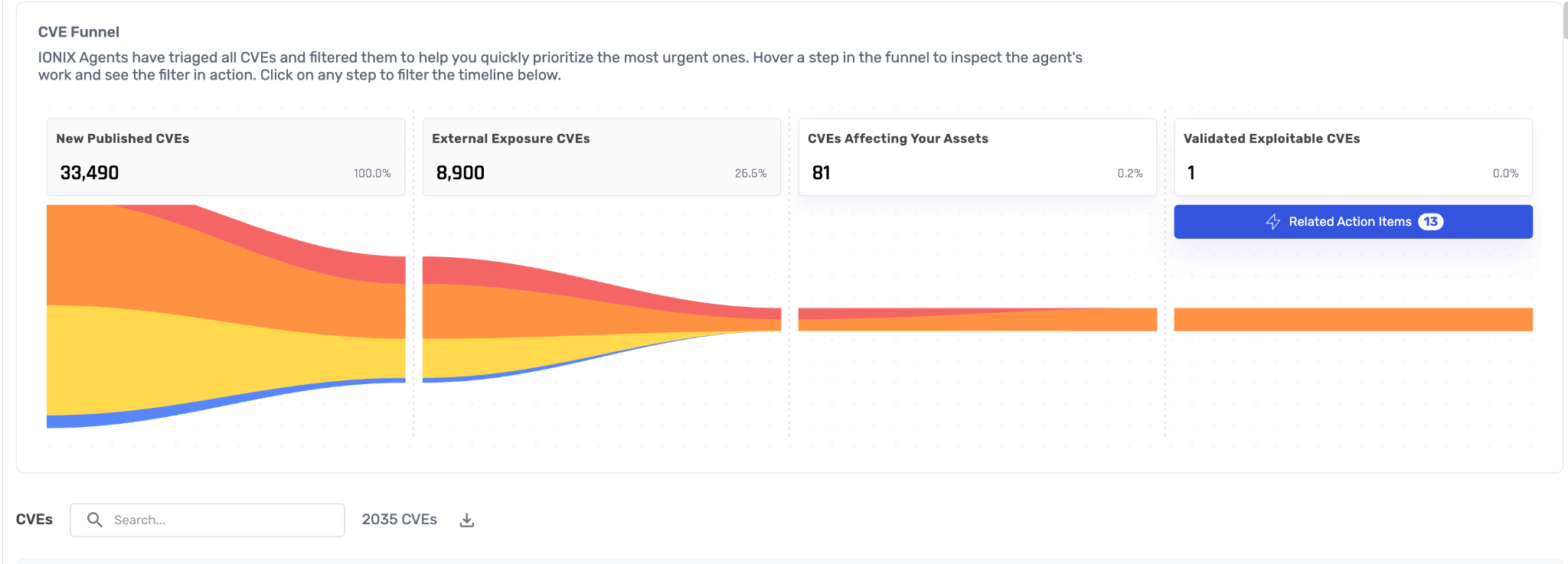
The commitment covers CVEs that affect internet-facing technology. In the 60 days to November 23, 33,490 new CVEs were published, and a little over 8,900 applied to external-facing technology. The rest, such as flaws that need local access to a device, are outside the scope of external exposure management.
PHP2Shell was our biggest test so far, the largest event of its kind since Log4Shell. By 8 a.m. ET the morning after it broke, IONIX’s Live Exposure Defense customers knew where they ran PHP, which versions, whether a WAF sat in front of it, and what to fix first. That was hours before the official patch was released.
8. Where does the AI agent have decision authority in that workflow?
We use AI at several points in the workflow, and how much it decides on its own depends on the step.
CVE triage. When a CVE drops, agents check whether it applies to an external attack surface at all, rather than trusting the advisory’s metadata.
Corporate structure. AI works out a company’s corporate structure and business assets, then produces a report a human can sign off on: why these entities belong to the company, and why these others don’t.
Technology detection. AI writes the detection rules. For cases we’ve done many times, like detecting a WordPress instance or a new WordPress plugin, we trust the AI to handle it on its own. For other technologies, an analyst looks at what the AI produced and either approves it or sends it back for refinement. We also run what the AI generates against our history of assets we know are running that technology, and score how it performs.
Exploit payloads. Our agents build and test the payloads. In many cases, when our guardrails determine a payload is safe, it runs without human review. When they can’t make that call, the system escalates, and one of our security researchers has to approve the payload before it runs.
That’s how escalation works in practice. Anything outside the routine cases goes to an analyst, who reviews the AI’s output and decides whether it’s ready or needs more work.
9. How do you verify that a temporary WAF rule reduced risk in production?
Today, we tell customers exactly which WAF rule to deploy, written for the specific WAF in front of that specific asset, whether that’s Akamai, Cloudflare or another supported vendor. The customer deploys it, so approval stays with their team.
We validate the rule ourselves first. Behind the scenes, we create it, deploy it to our own WAF instances internally, and see whether it actually blocks the attack.
For customers using IONIX WAF Posture Management solution, we keep checking their WAFs, including whether they’re in blocking or logging mode and whether a configuration has regressed. Once the customer applies the permanent fix, we validate that the exposure is closed. Where we’re heading is closing that loop automatically, through the controls customers already own.
10. Walk us through one anonymized production case from disclosure to verified closure.
I keep coming back to PHP2Shell because it happened just last month, and it’s the clearest example we have of the full cycle.
The first signs appeared on the night of Tuesday, October 20, Israel time, where our research team is based. There was no official NVD record yet and little detail on how the flaw could be exploited.
By the next morning, we had published an advisory listing each customer’s PHP assets, and subscribers got an email alert as soon as it went up.
By mid-afternoon, detailed mitigation and remediation guidance was out in the IONIX platform, pushed to customers proactively by email and on a live blog.
By 5 p.m., when the official patch arrived, our research team had built a new detector for the specific vulnerable configuration, which narrowed the list to only the assets actually affected.
The next day, customers had that narrowed list and a plan for where to start. In IONIX Live Exposure Defense, any CVE that touches a customer’s assets has a “What should I fix first?” button. One click returns a plan that groups the assets by priority and explains, for each one, why it matters, how likely it is to be exploitable, what WAF sits in front of it, and what to do next.
From there, the decisions were the customer’s: patch, upgrade or take a system offline. When customers make the fix, we validate that it worked.
Most of the time sat on the customer side, in their own patch and change processes. That’s where it usually sits. The other place time goes is the early stage, before a safe test exists. Our first list is deliberately broad, and it tightens as the evidence comes in, because missing an affected asset is worse than flagging one that turns out to be fine.
Outside of a crisis like PHP2Shell, the same process runs every day. Here’s what that looks like in one of our test environments over the last 60 days. Of the 33,490 new CVEs published in that time, a little over 8,900 applied to external-facing technology. Only 81 affected technology the environment actually runs, and one of those was confirmed remotely exploitable, across 13 assets. That’s where a security team should start.
Closing thought
For most of this category’s history, the output has been a list. The lists got longer and better ranked, but someone still had to review the findings, work out which ones mattered, and fix them at human speed. That doesn’t hold up when the thing attacking you runs around the clock.
That’s why we’re building IONIX into a self-healing attack surface. It finds what’s exposed, confirms what’s exploitable, and fixes it before an attacker gets there. Closing an exposure automatically, without breaking the business, depends on knowing three things at once: exactly what you own and how it’s connected, the moment a new CVE turns one of those assets into a target, and what the controls in front of it are configured to do right now. Most of the industry still has to build that map. We start with it.
If it’s there, IONIX will find it and fix it, before an attacker.

John Kevin Hao is a news and feature writer covering cybersecurity, technology, and business targeted for professional audiences.